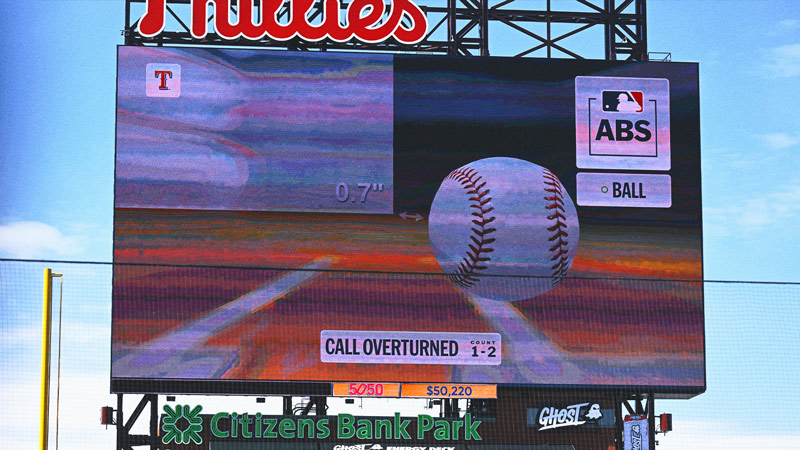
Now that we have a sense of how the Automated Ball-Strike (ABS) Challenge System is used in an MLB game, what are our initial impressions? Consider FOX Sports' Dontrelle Willis a fan. "I love it for multiple reasons," Willis said when asked about his early impressions of the ABS challenge system on Monday night. "No. 1, how they're doing it, it's very quick. Also, they're using the scoreboard, so the fans can interact with it, so the speed of it is elite. "Also, strategically, how managers are using it: Who's going to be able to call it? They're taking it out of the pitchers' hands. [Seattle Mariners manager] Dan Wilson and [Athletics manager] Stephen Vogt said the pitchers do not have that responsibility. It's either going to be on the hitter or the catcher we trust behind the plate." In what's its first full season in the big leagues (the ABS Challenge System was previously used in the minor leagues and during the 2025 MLB All-Star Game), teams get two ABS challenges per game, with only the pitcher, catcher or hitter able to challenge a call promptly after a pitch. A graphic of the pitch relative to the strike zone then appears on the big screen to determine if the pitch was a ball or a strike. If a team correctly challenges a call, they keep their challenge. Should the game go to extra innings and a team has exhausted its challenges, they get another one for the extra inning and every one that follows. "That's going to be a team-to-team thing about who they trust. There are some guys in the locker room who think everything is a strike or a ball, and there are some guys that you trust that have really good eyes that walk and take a lot of pitches," Willis said about the strategy for teams in challenging calls. "When are you going to use this ABS? Who's going to use it? What type of count? You are going to see, day by day, different scenarios. Hey, you might have bases loaded, a 3-2 count and a close pitch in the first inning; that could be the game for you if you feel that way. If you get the call right, hey, you retain that. But, if not, it's going to be tricky." Willis also noted that he agrees with teams taking the decision to challenge calls out of pitchers' hands because their "depth perception" can be different from a catcher or hitter due to the angles they're releasing pitches at. Through the first series of the 2026 MLB season (series began as early as Wednesday, Mar. 25 and ended as late as Sunday, Mar. 29), catchers were successful on 64.1% of their challenges; hitters were successful on 42.3% of their challenges; pitchers were successful on 40.0% of their challenges; in all, 53.7% of challenges by teams were successful.
Sports1
Syndicated article · via api.foxsports.com
Dontrelle Willis on MLB Automated Ball-Strike Challenge System: 'I Love It'
Now that we have a sense of how the Automated Ball-Strike (ABS) Challenge System is used in an MLB game, what are our initial impressions? Consider FOX Sports' Dontrelle Willis a fan. I love it for multiple reasons,…