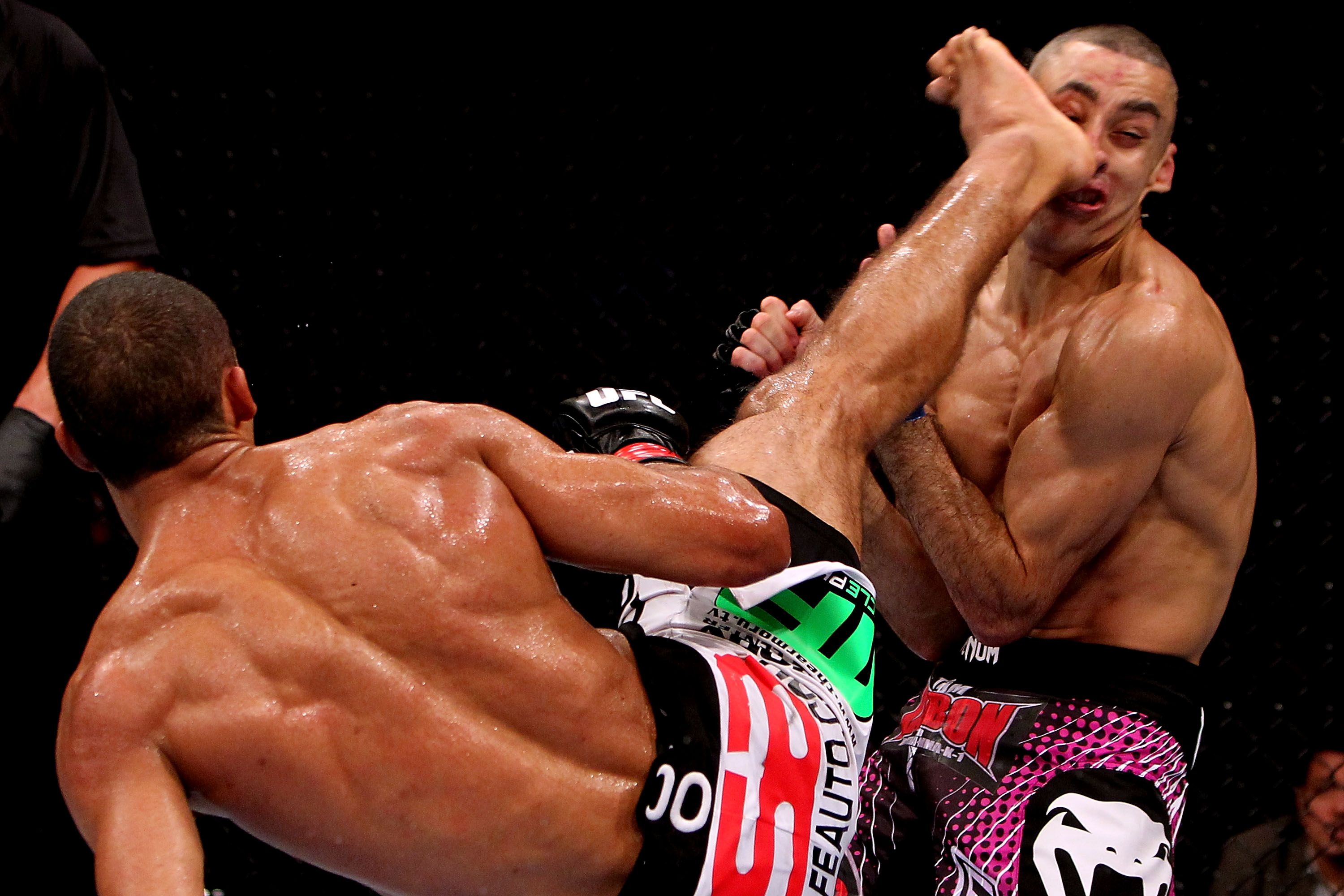
If you want to feel like a dusty old-timer in the MMA world, go ahead and try to tell the kids these days about Edson Barboza. See how far you get. Here's a guy who broke into the UFC in 2010, earning the rare TKO victory via repeated, agonizing leg kicks at UFC 123. Then he just stayed there, at the highest level of the sport, battering thighs and ribs and skulls with some of MMA's scariest kicks in two of MMA's most competitive weight classes for the next 15 years. Until this past Saturday. That's when, following a second-round TKO loss to Esteban Ribovics at UFC 330, the 40-year-old Barboza announced his retirement. "I [want to] just say thank you," a tearful Barboza told the Philadelphia crowd after the loss. "I give my best every single day, guys. Every single fight, I promise, I give my best. I really give my best. So thank you. I hope you guys enjoy."
I can admit it, I got a little misty. It wasn't just the contrast of a man crying through swollen, bruised eyes while saying something heartbreaking about how he hopes we enjoyed all this. It wasn't even (or at least it wasn't only) the reminder of my own mortality. Here was a guy whose entire career I covered — I remember sitting there at cageside for his first few UFC fights in Newark and Rio de Janeiro, both of which earned him "Fight of the Night" honors back when he was just a wide-eyed young buck — and now he was hanging up the gloves.
But it was also something about that specific phrasing he chose. "Every single fight, I promise, I give my best." Who could possibly disagree with that? No one who watched any significant portion of his 33-fight career in the UFC. And yet what does that mean to people in this sport? What value do they place on that, and how often do they even think about it? Put the question another way: When you look at his career as a whole, was Edson Barboza what you might call a “journeyman” fighter? Stripping away some of the more negative connotations of the phrase, I think the answer is probably: Yeah, pretty much. Barboza never fought for a UFC title. He was never one of the top-ranked fighters in any division. The four-fight win streak that kicked off his UFC tenure was the longest stretch of victories he'd ever have again. He was not, in that sense, one of the elite fighters. He was not a contender. He was just a guy who showed up and fought his heart out across four different presidential administrations and four different UFC broadcast deals. He gave his best, in other words, just like he said. Sometimes his best was good enough to get the win and other times it wasn't. But you always knew more or less what you were going to get from him. There was a certain baseline level of effort and violence and general toughness that you could count on, as evidenced by the fact that he won 10 separate "Fight of the Night" bonuses — with the first of those coming in 2011 and the last coming in 2024, which tells you something. Barboza authored one of the greatest knockouts in UFC history in his 2012 bout against Terry Etim. Josh Hedges via Getty Images
But yeah, a guy who wins some and loses some and never rises to any point all that near the top of any division? The fight game has typically branded such figures as journeymen. Fighters hate terms like that for the same reason they hate terms like "gatekeeper." It feels limiting to them. It's like someone telling them, based solely on past wins and losses, that this is all they are and all they'll ever be. It feels like a dismissive bit of pigeonholing, so it makes sense that they aren't crazy about it. Still, don't fight sports need journeymen? Aren't they pretty damn essential, when you think about it? Barboza put in 15 long years on the job, and in the process he became an undercard staple in the UFC. When we saw his name on fight cards, we instantly knew who he was and what we could expect when he came to fight. We also knew what a win over him meant. Khabib Nurmagomedov. Justin Gaethje. "Cowboy" Cerrone. Tony Ferguson. Paul Felder. These were pretty much the only types of opponents Barboza was losing to in his prime years. They made their names, in part, off his. He was a known quantity against whom others could be measured. That's an absolutely vital role that has to get filled somehow, otherwise all we're watching is mindless unarmed combat that goes nowhere and signifies nothing. The aftermath to Tony Ferguson vs. Edson Barboza. This is what it took to beat Barboza in his prime. Jeff Bottari via Getty Images
But I think what we need to pause and appreciate is more than just the role Barboza performed in the larger UFC ecosystem. It's also just the basic, factual reality of what it means to show up and give your best for 15 uninterrupted years in a sport like this. The injuries. The broken bones. The cuts and the bruises and the full-body trauma. And a lot of that is just in the gym. Putting in that kind of work in the sport over that many years is like signing up for a couple car crashes per year. You really have to want to be there. And even if you do want to be there, you've got to find a way to keep wanting it, even as your youthful exuberance gets beaten out of you. You've got to keep waking up all through your thirties and into your early forties, feeling the reminders of everything you've done to yourself every time your feet hit the floor in the morning, then find a way to drag yourself to the gym and do some good once you get there. To say that's not easy doesn't come anywhere close to capturing it. It's damn near Herculean, is what it is. When we think of it in the abstract, a fighter who simply shows up and does his best doesn't seem like anything special. When we see what it actually looks like over the course of an entire career, that's when we realize that it's a rare achievement which comes at immense cost. Is giving it your best enough? In so many ways, the fight game says no, not even close. We celebrate champions and argue over GOATs and mostly don't spare a thought for anyone else. This just isn't the kind of sport that loves a role player. But to give it your best the way Barboza did, and for as long as he did? It's almost a quiet little miracle that happened right under our noses. And then it ended.