I was an early medical student at the University of Miami in Florida, seeing a patient in a local primary care clinic. “Abdominal pain with constipation,” I proudly told my supervising physician. “I think it’s irritable bowel syndrome.”
We went to see the patient and I watched with self-satisfaction as he asked the same questions I had. When did the pain start? Where is it? I waited for him to tell her it was likely IBS. But he didn’t. He paused and looked at her face after his last question, and for the first time I noticed she wasn’t making eye contact. She was looking at the ground. “We’ve known each other for a long time,” he told her gently, “and you seem worried. Can you share what you’re thinking?”
She didn’t say anything right away. Finally, she looked up. “My sister was just diagnosed with stage 4 colon cancer. I’m worried I might have it too.”
For the next 15 minutes I watched as they talked about how she was processing her sister’s diagnosis, her fears about the future, what it all meant for her future colon cancer screening, and why at this point we were most concerned about IBS.
By the end of the visit, her expression had cleared; I realized I hadn’t noticed how frightened she was. I felt ashamed of myself. What kind of doctor was I going to be?
My supervising physician and I talked about it. “You learn how to look,” he said. “When you care, you get a feel for it.”
You get a feel for it.
That lesson has stayed at the forefront for me as I’ve watched artificial intelligence sweep through medicine and enter the clinical environment of our internal medicine residency program at the Johns Hopkins Hospital. AI scribes. Chatbots that tell you a differential diagnosis if you put in a patient’s symptoms. Electronic medical record tools that will summarize a patient’s hospital course for you. But they can’t feel.
To be sure, AI can do incredible things in medicine. In this new world, I hear trainees wonder if AI will make doctors obsolete. I also hear some—usually not physicians—make this claim with confidence. They’re right about one thing: medicine is changing, and we in health care need to figure out our place in this new world.
But they’re wrong that physicians will become obsolete as AI becomes better at processing information. As I learned in medical school, truly caring for a patient begins before the first question is asked and the first test is ordered. It begins with looking. Noticing a second of hesitation before a patient responds. Seeing the pits in a nailbed. Hearing a change in heart sounds between visits. It begins when you commit to focusing entirely on the person in front of you, and to creating a relationship—that’s how you get a feel for it.
AI excels at processing information that is presented to it, like symptoms, test results, and even human expressions. It reasons with the input it is given. But it cannot decide what deserves attention before data exist.
Great physicians define the input. They decide which symptoms matter, observe what wasn’t said, and understand what information deserves the most attention. They are curious about the patient in front of them, and that curiosity drives them to dig deeper, discover information an algorithm couldn’t, and direct the flow of information—not just receive it.
Ironically, healthcare systems are already pushing physicians away from careful observation and curiosity toward the kind of medicine AI performs best: documenting, checking boxes, and following protocols. As a result, now many physicians don’t get the chance to experience the “feel” of medicine. Some ask questions (input) and tell the patient the plan (output)—but don’t observe or connect. They don’t have the time to practice the aspects of medicine that distinguish them from software.
Could AI in the coming decades replace these doctors? Probably. If the input is just data, the output would probably be the same. But the patients’ experience will be the one I would have given my patient with abdominal pain: incomplete and ineffective.
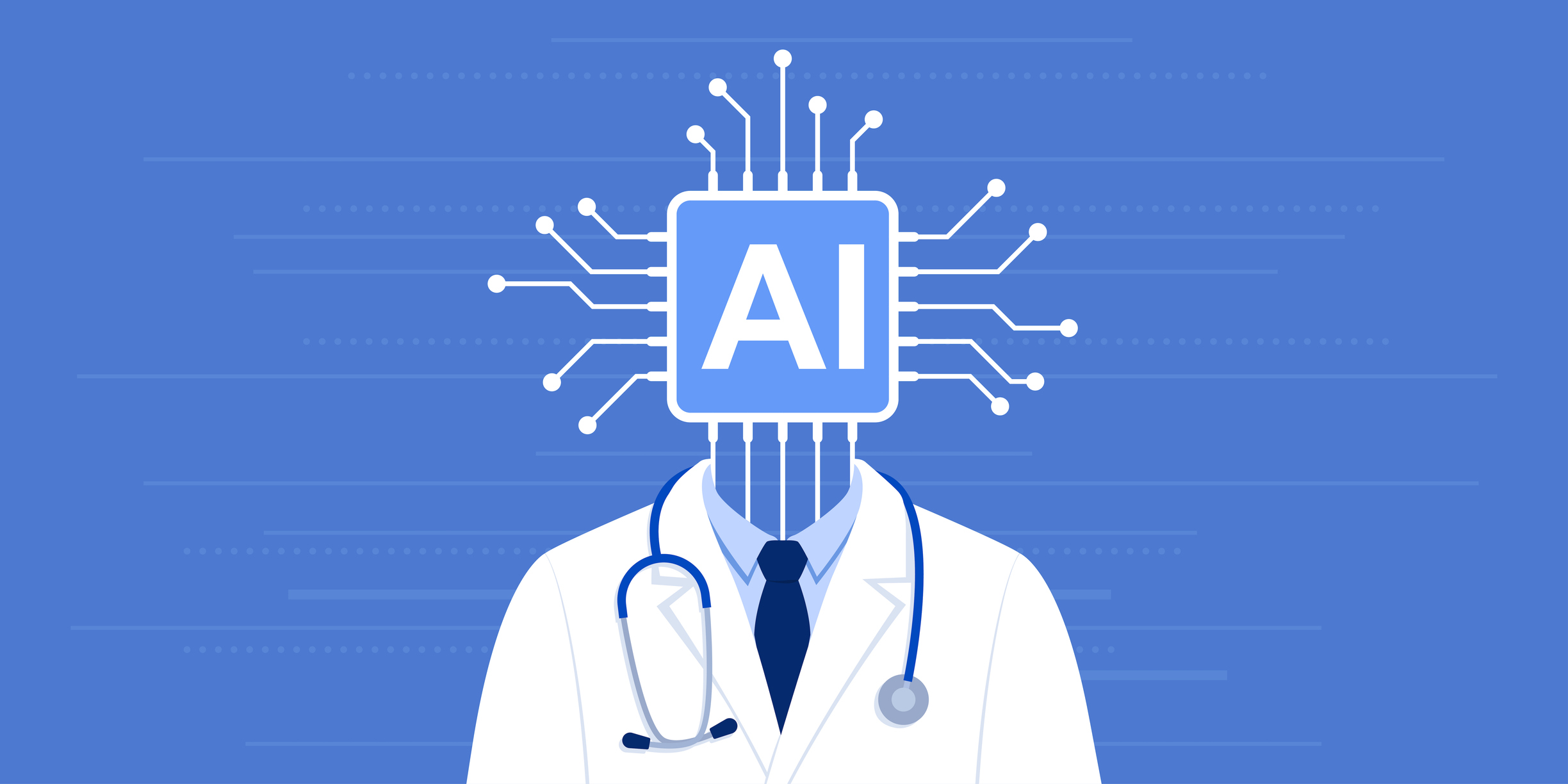
We need to embrace what AI can do to make medicine better while at the same time recognizing what it cannot do. We must see it for what it is—an adjunct to elevate physician care. A modern stethoscope.
Healthcare workers need to inform how medical AI is developed and deployed, so it doesn’t propagate checkbox medicine and promote the creation of AI-equivalent physicians who can follow protocols but have no feel for medicine.
We need to reimagine how we train the next generation of physicians, prioritizing the development of the skills and attributes needed to define the input—curiosity, careful observation, expert communication, and mastery of the physical exam—in the context of AI tools.
It also means we need to focus on recruiting people to medicine who have the “soft skills” and attributes that have defined great physicians for centuries: a focus on serving others, forming connections, building trust, and empathizing.
Years later, I remember little about the details of my patient’s abdominal pain. But I distinctly remember the moment she looked up after my supervising physician asked the question I never thought to ask.
AI will become better at recognizing disease. Whether medicine becomes better at recognizing patients depends on whether physicians still learn to look—and learn to feel.